| |
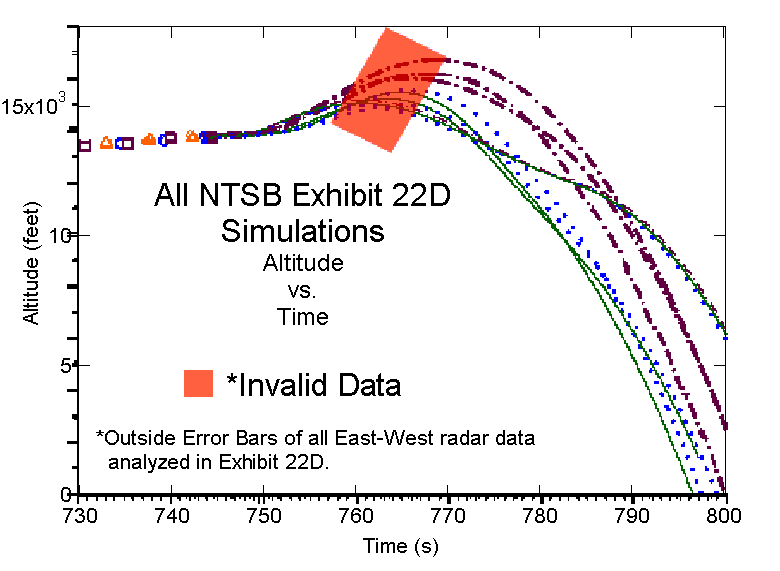
Compiled Simulation Data from NTSB Exhibit 22D. Orange box added by FIRO.
|
A Review of the Federal Crash Sequence Simulations of TWA Flight 800
The National Transportation Safety Board's (NTSB's) crash sequence simulations diverge from the radar-tracked course and airspeed of the accident aircraft. When the simulations show Flight 800 climbing sharply and slowing down, FAA radar sites recorded the actual aircraft maintaining its airspeed. Since there was no decelaration and the aircraft's engines had inadequate thrust on their own to maintain a rapid ascent, the law of conservation of energy excludes any such ascent.
The simulated steep climbs resulted from the simulated removal of the forward fuselage from the rest of the aircraft four seconds after the initiating event. No other damage is factored into the NTSB simulations--damage that could have caused the aircraft to turn left quickly after the initial explosion, as FAA radar sites recorded. This turn apparently allowed Flight 800 to maintain its airspeed, while preventing it from climbing after losing its forward section.
In December of 1997, the NTSB held a public hearing on the crash of TWA Flight 800. At this hearing, a The Main Wreckage Flight Path Study (Exhibit 22C) was released that showed two "data fitting" crash scenarios that included Flight 800 climbing a maximum of 1,300 feet in altitude immediately following the initiating event. Two years later when Flight 800 Independent Researchers Organization (FIRO) received and analyzed the raw radar data, the group learned that the jetliner did not slow down at a time when government simulations showed the aircraft climbing quickly.
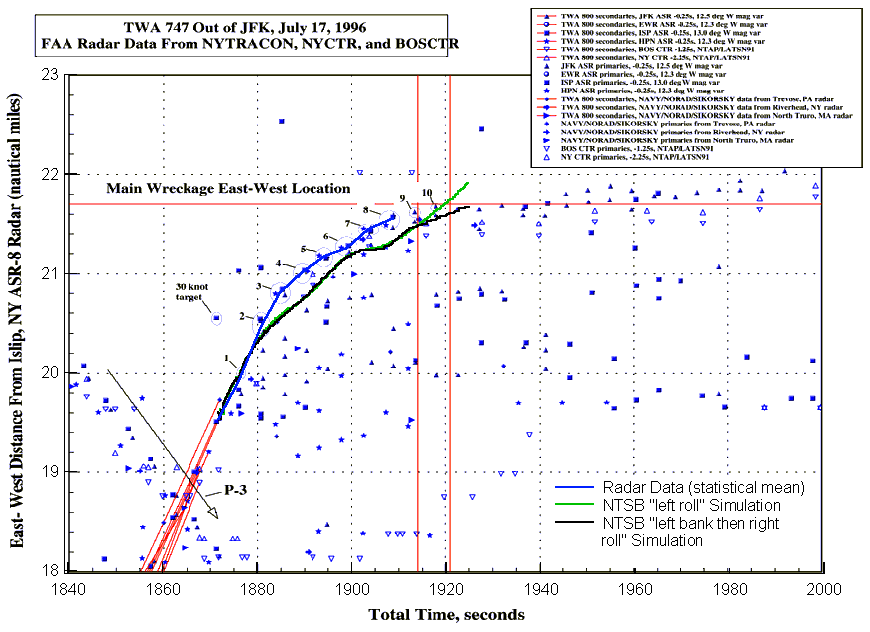
Figure 1: East vs. time plot from NTSB Exhibit 13A and 22C. Radar trace of the main wreckage (circled and numbered data), statistical mean of radar trace (blue line), and NTSB simulations (green and black lines).
FIRO showed that the simulation data did not match the radar data (Figure 1) and explained that the proposed climb was the reason at a nationally televised (C-Span) press conference on August 27, 1999. Five months later and in an apparent response to this press conference, the NTSB released Addendum I to Exhibit 22C--a follow-up report to the original simulation exhibit.
Exhibit 22C-Addendum I (originally named Exhibit 22D)
This follow-up report included error bars for each radar point of approximately 1/16th of a mile or less, based on information obtained from the FAA. Simulations that did not fall within these error bars were highlighted in the report and apparently considered invalid.
The NTSB considered three types of simulations in exhibit 22D: fast; nominal; and
slow. "Fast" meant that the drag force was minimized, while maximizing
the upward pitching moment caused by an alleged downward rotation of the
nose during its separation from the plane. "Slow" meant that the drag was maximized and the upward pitching moment minimized. "Nominal" simulations were likely an average of "Fast" and "Slow," but there is no explicit definition within exhibit 22D.
The author of Exhibit 22D never acknowledges that all simulations are outside the uncertainty boxes, but does acknowledge that some are. He directs the reader's attention to "East vs. time" plots after detailing the first two simulations.
Slow Simulation: "As can be seen from the East vs. time plot in figure 6, the slow simulations for all the radars are outside the radar band for the event."
Nominal Simulation: "As can be seen from the East vs. time plot in figure 11, the nominal simulations for all radars are outside the radar tolerance in the region between approximately 755 and 770 [seconds]."
Readers therefore are correctly lead to believe that the first two simulations (slow and nominal) are invalid due to being "outside the radar tolerances" for at least 15 seconds during the simulated steep climb.
Fast Simulation: Here, the author directs the reader's attention to a "North vs. East" plot (figure 15) stating,
"As shown in figure 15, the fast simulations flew very close to the radar points."
But what about the "East vs. time plot" for the fast simulation? This is the plot that apparently made each of the first two simulations invalid. Is the fast simulation's data within the error bars? No, these simulations too are outside the radar tolerances for 15 seconds during simulated climbs. The ISP simulation does cross through the radar tolerances briefly during this time, but is outside the radar tolerances for the majority of the simulation.
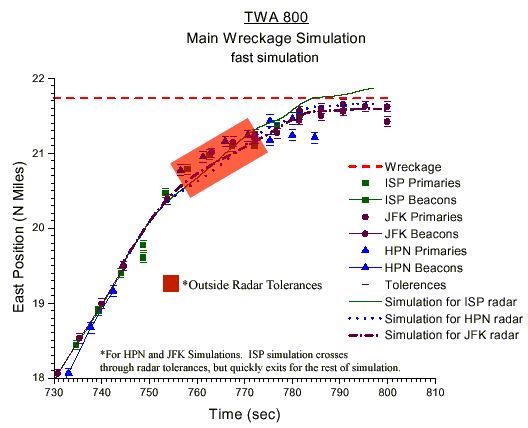
Figure 2: Figure 16 from NTSB Exhibit 22D. An orange box has been added by FIRO to highlight deviations from radar tolerances. Deviations occur when simulation curves drop below the error bars. In a distance vs. time plot such as this, the less steep the curve, the slower the aircraft is traveling.
The last simulation shown in Exhibit 22D is another "nominal" simulation, but maximizes the time of nose departure. It also doesn't consider data from the two FAA radar sites referenced in the initial report, one site at the MacArthur Islip Airport being the closest to the crash.
Nominal Simulation with late nose departure: The author does not comment on whether or not this simulation is consistent with any plot. But, the reader can see clearly that once again, this simulation is outside the radar tolerances for 15 seconds during simulated climbs.
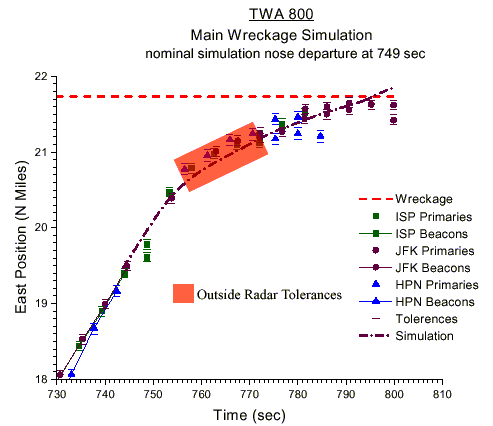
Figure 3: Figure 21 from NTSB Exhibit 22D. An orange, rectangular box has been added by FIRO to highlight deviations from radar tolerances. Deviations occur when simulation curves drop below the error bars. In a distance vs. time plot such as this, the less steep the curve, the slower the aircraft is traveling.
The above inconsistencies between all NTSB simulations and the radar data occur at a time when Flight 800 is alleged to have climbed sharply. Figure 4 below is a composite of all exhibit 22D simulations for altitude vs. time and illustrates when the simulations fall outside of the radar tolerances.
Figure 4: Altitude vs. time for all exhibit 22D simulations. An orange, rectangular box has been added by FIRO to highlight deviations from radar tolerances.
All existing NTSB simulations exit the radar tolerances within 14 seconds of the initiating event, while Flight 800 is alleged to be climbing sharply by federal investigators. The orange box in Figure 4 helps understand this fact by showing that the divergence from the radar data occurs when the simulated aircraft is put into a steep climb.
Conclusion
The author of Exhibit 22D matched speculative simulations with individual radar datasets. Each simulation presented was outside the radar tolerances of each individual dataset during a time period when the plane was alleged to have climbed sharply. A natural conclusion from these results would be that the plane did not climb as steeply as alleged, or perhaps not at all. Unfortunately, the NTSB has not published a single simulation based on Flight 800 either descending or simply not climbing immediately following the initiating event.
The NTSB has acknowledged that the front section of the plane detached early in the crash sequence, and used this fact, and this fact alone, to manipulate flight characteristics during steered simulations. No mention is made in either simulation exhibit of other types of damage found in the wreckage that could also affect the flight path. Such unknowns should be acknowledged and considered by the author of the two simulation exhibits. Then, by justifiably considering the possibility that Flight 800 did not climb sharply after breaking in two, a new simulation could be generated that may match the radar evidence and therefore accurately describe the main wreckage flight path.
Note: To fully understand the NTSB's decision not to create simulations or animations of the aircraft descending after exploding rather than climbing--simulations that could have matched the aircraft's radar-tracked flight profile--see this review of the eyewitness evidence. The NTSB needed and cited the simulated climb, invalid or not, to explain 182 eyewitness reports of a rising streak of light seen before Flight 800 fell out of the sky in flames.
NTSB Exhibit 13A
NTSB Exhibit 22C
NTSB Exhibit 22C-Addendum I (originally named Exhibit 22D)
Evidence the Main Wreckage Didn't Climb
For a Better Understanding of Simulation Data
Eyewitness Evidence
Altitude Adjustments
|
